2.7 Car Coaster Canva SVG Templates
A Designer’s First Glance: Clean, Minimal, and Surprisingly Versatile
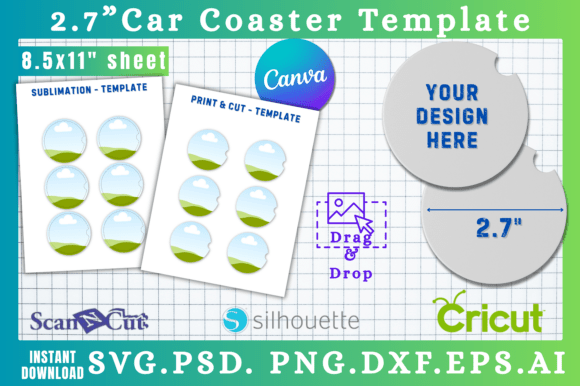
When I opened 2.7 Car Coaster Canva SVG Templates, my first thought wasn’t “cute” or “trendy”—it was “this will stitch cleanly.” The design reads as a subtle, confident blank canvas—not empty, but intentionally open. Its 2.7-inch diameter fits neatly inside standard embroidery hoops without crowding, and the 8.5 x 11 sheet layout means you can easily isolate, resize, or duplicate it in Canva for batch production. As a designer who’s stitched everything from baby onesies to boutique aprons, I appreciate how little visual noise this template carries. It’s not shouting for attention; it’s waiting for your voice—your font choice, your thread palette, your client’s name or brand mark—to bring it to life.
Where It Shines: Real Projects, Real Stitching
Last week, I used 2.7 Car Coaster Canva SVG Templates as the foundation for a set of personalized embroidered kitchen towels for a local café’s holiday gift bundle. I added a simple monogram in satin stitch and a tiny seasonal icon (a pine sprig) in fill stitch—both scaled comfortably within the 2.7" boundary. The result? Crisp edges, no thread nesting, and zero distortion on medium-weight linen-cotton blend. That same template later became the base for a small-batch run of embroidered patches for a maker’s Etsy shop—heat-applied to denim tote bags. Because the outer shape is clean and rounded, it framed the custom lettering beautifully without competing. It also worked well on baby onesies: the compact size avoided bulk around the shoulder seam, and the smooth perimeter minimized irritation against delicate skin.
Where to Pause—and Test—Before Committing
Don’t assume 2.7 Car Coaster Canva SVG Templates behaves the same on every fabric. On stretchy knits like cotton jersey (think sweatshirt cuffs or toddler tees), I recommend using cutaway stabilizer and reducing stitch density slightly—especially if adding fine details like thin borders or script text. On dark fabrics, contrast matters more than you’d think: a light thread on navy can look washed out unless you add an underlay or increase stitch coverage. And on curved surfaces—like the front panel of a structured cap—the 2.7" circle may subtly warp if hooped too tightly. Always test on scrap fabric first, especially when layering (e.g., appliqué over twill tape or a patch backing).
Small Details, Big Impact
If you’re planning to add lettering or icons inside the coaster outline, check corner clarity and spacing. Tiny serifs or tight kerning won’t translate cleanly at this scale in satin or running stitch. I found that sans-serif fonts with generous spacing held up best—even at 10–12 pt size in the embroidery software preview. Also, avoid dense fill areas near the edge: they can cause puckering on lightweight tea towels or gauzy nursery blankets. A light fill stitch or strategic use of running stitch as an outline helps maintain drape and softness.
What This Template Says About Your Brand—Without Saying a Word
Using 2.7 Car Coaster Canva SVG Templates in your finished product quietly signals intentionality. It’s not a crowded clipart mashup—it’s a considered frame. Customers notice that. When I included these on handmade aprons sold at a craft fair, buyers consistently commented on how “clean” and “professional” the embroidery looked—even though the design itself was minimal. That perception lifts perceived value, builds trust in your craftsmanship, and makes personalized gifts feel truly bespoke. For Etsy sellers, that translates directly into better photo mockups, stronger branding cohesion across listings, and repeat customers who return for consistency, not just novelty.
Practical Notes Every Embroidery Designer Should Keep Handy
- Always test first: Run a sample on your target fabric + stabilizer combo before stitching client orders or inventory batches.
- Check thread color contrast: View your design in grayscale mockups—what looks balanced on screen may vanish on fabric.
- Review stitch density: High-density fills can overwhelm small hoops or stiffen lightweight materials. Adjust if needed.
- Confirm hoop compatibility: While 2.7" fits most 4" hoops comfortably, verify your machine’s minimum recommended size for clean registration.
- Inspect small features: Zoom in on corners, curves, and text—look for overlapping paths or stray nodes that could cause stitching errors.
- Compare light/dark backgrounds: Try your design on both white and charcoal fabric previews to assess legibility and balance.
- Use proper stabilizer: Tear-away works for stable wovens; cutaway is safer for knits or high-wear items like tote bags.
- Verify licensing: Since this is a Canva-based graphics file, confirm whether commercial use—including selling finished embroidered products—is permitted before listing on Etsy or in your small shop.
Final Thought: Less Is Strategically More
2.7 Car Coaster Canva SVG Templates isn’t flashy—but that’s its strength. In a market saturated with overdesigned digital embroidery files, this template gives you breathing room. It supports storytelling (a name, a date, a tiny symbol), honors fabric texture, and scales gracefully across product types—from baby embroidery to holiday embroidery to commercial embroidery for local brands. It doesn’t try to do everything. It does one thing exceptionally well: provide a reliable, stitch-ready frame for what matters most—your idea, your hand, and your customer’s moment.