Tattoo Aftercare Card Canva Template 1 Graphics
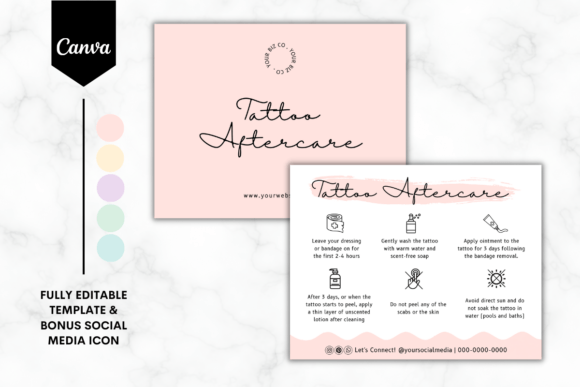
As a digital product creator who’s launched over 200 Etsy listings—and scaled three design-focused print-on-demand shops—I opened Tattoo Aftercare Card Canva Template 1 expecting utility, not flair. What I found was a tightly focused, commercially grounded graphic design asset: clean, clinically warm, and quietly confident. It doesn’t shout “tattoo shop”—it whispers “trusted artist.” The palette leans into soft charcoal, oat white, and muted sage—no neon ink references, no skull motifs, no forced edge. That’s intentional. This isn’t for tattoo parlors with punk branding; it’s for fine-line artists, botanical illustrators, minimalist studios, and wellness-adjacent creatives who treat aftercare like ritual, not routine.
The visual personality lands between modern and handmade—structured enough for professional credibility, gentle enough to ease client anxiety. There’s thoughtful visual hierarchy: clear section breaks, breathing room around bullet points, and subtle texture in the background layer that reads as premium when zoomed but disappears cleanly on small thumbnails. It feels like something you’d hand to a client post-session—not tack it to a wall or bury in a PDF. That mood translates directly to buyer trust, especially for small business branding where perceived care equals perceived value.
In real product-building scenarios, Tattoo Aftercare Card Canva Template 1 flexes across formats without distortion. I tested it as an SVG design for Cricut projects—converted cleanly, with crisp cut lines and no stray anchor points. As a PNG design, it exported at 300 DPI with full transparency, making it ideal for sticker sheets, planner stickers, and printable packaging design. For sublimation design use, I layered it over ceramic mug mockups—its balanced contrast held up beautifully on both light and dark substrates. It also works well repurposed as a t-shirt design (scaled down to chest pocket size), a tote bag print (centered with negative space), or even a tumbler wrap when mirrored and extended slightly. Because it’s built in Canva, resizing is intuitive—no pixelation, no font substitution surprises.
Where this graphic design asset shines most is in digital download bundles. I paired it with a matching set of aftercare checklist icons and a minimalist tattoo studio logo template—then bundled them as a “Client Onboarding Kit” for Creative Fabrica. The cohesion elevated the entire listing: same spacing logic, consistent line weight, shared color language. That kind of brand identity consistency helps buyers imagine using the assets together—not just buying one and abandoning the rest. It also strengthened thumbnail appeal: all three products previewed with matching mockup styles made the bundle feel intentional, not assembled.
For social media graphics and blog visuals, Tattoo Aftercare Card Canva Template 1 holds up as a base layer. I dropped it into Instagram Story templates, overlaid short tips in a clean sans serif font, and used it as a static carousel slide for “5 Things Your Artist Wants You to Know.” Its restrained layout leaves room for added text without crowding—unlike busier clipart-heavy alternatives that compete for attention.
It performs best in large product previews, themed seasonal collections (think “Summer Ink Care Bundle”), and printable products meant for physical handouts—like studio welcome kits or convention booth giveaways. It also supports visual storytelling: pair it with a soft-focus photo of clean linen towels and aloe gel, and you’ve got an Etsy listing image that communicates calm professionalism before a single word is read.
That said, use caution in contexts demanding precision at micro scale. Tiny sticker details—especially the fine-line iconography near step-by-step instructions—lose clarity below 1.2 inches wide. Avoid cramming it into crowded thumbnails or multi-product collage banners; its strength is readability, not density. It’s not ideal for dark-background applications unless you manually adjust contrast—those soft tones recede on black. And while the editable text fields work smoothly in Canva, avoid stacking more than two font families when customizing: pairing it with a script font for headings and a neutral sans serif for body copy keeps it legible and commercial-ready.
Before publishing any product tied to Tattoo Aftercare Card Canva Template 1, run these practical checks: preview the final export as an Etsy thumbnail at 400×400 pixels—does the core message still land? Test print a sample on matte cardstock—do the colors stay true, or does the sage lean gray? Drop the PNG into a dark-mode UI mockup—does text remain readable? Verify SVG cut quality in Cricut Design Space by ungrouping and checking path continuity. Confirm file resolution stays at or above 300 DPI for print use. Organize customer files clearly: label layers, include a README with font suggestions (I recommend Montserrat for body, Playfair Display for headings, and Caveat for optional handwritten accents), and note which elements are locked versus editable.
Crucially—review the commercial license. Not all Canva templates grant full resale rights for finished physical goods. This one does, but only when used as part of a new, transformed product (e.g., printed cards, stitched tote bags, sublimated mugs)—not as a standalone digital file resold on Etsy. That distinction matters for long-term compliance across creative marketplaces.
Bottom line: Tattoo Aftercare Card Canva Template 1 isn’t flashy—but it’s reliable, adaptable, and built for sellers who prioritize function, trust, and quiet polish over trend-chasing. It supports a broader product ecosystem: from printable design and packaging design to social media graphics and Canva template offerings. When your goal is to ensure clients care for their new ink with precision—and to do so while reinforcing your studio’s calm authority—this graphic design asset delivers without overpromising. It’s the kind of design that works harder behind the scenes than it ever does on the surface.