Printable Business Card Canva Template
A Designer’s First Glance: Clean, Flexible, and Quietly Strategic
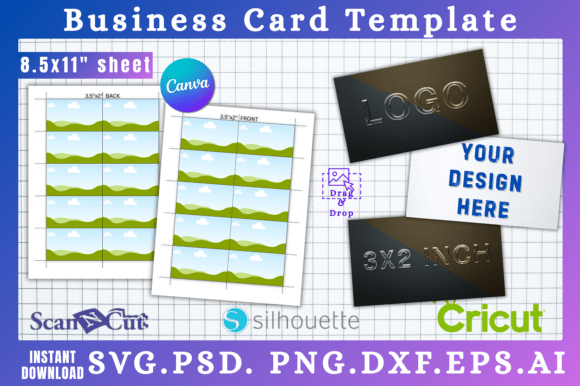
When I opened the Printable Business Card Canva Template, my first thought wasn’t “cute” or “trendy”—it was “this breathes.” There’s no forced whimsy, no overdesigned borders or cluttered corners. Just a clean, centered layout built for an 8.5 x 11 sheet—meaning it’s designed to be printed, cut, and used as-is—or adapted thoughtfully for embroidery prep. As someone who regularly translates digital graphics into stitched reality, I appreciated how uncluttered the space feels: generous margins, balanced negative space, and typography that suggests clarity over decoration. It doesn’t shout—it invites intention.
Real Project Test: Embroidering a Boutique Tote Bag for a Local Bakery
Last week, I used the Printable Business Card Canva Template as the foundation for a custom embroidered canvas tote bag for a neighborhood sourdough bakery. Their logo is simple—a hand-drawn wheat stalk—but they needed a clean, professional way to add contact info, social handles, and a small tagline underneath. Instead of building from scratch in embroidery software, I dropped their branding into this template, sized it for a 4” x 6” hoop, and digitized just the text block and subtle divider line. The result? A crisp, confident finish that looked handmade—not templated. Customers noticed the spacing, the even baseline alignment, the way the font weight held up at 8pt stitch height. That’s not luck. That’s thoughtful layout scaffolding.
Where This Template Shines (and Where It Needs Your Eye)
The Printable Business Card Canva Template works best when treated as a *starting point*, not a finished embroidery file. It’s not a machine embroidery design—it’s a graphic asset. That distinction matters:
- For custom apparel: Use it to mock up placement on sweatshirts or t-shirts before digitizing. Its proportions help you visualize how much real estate your business details will occupy—and whether tiny lettering will vanish in fill stitch.
- For embroidered patches or aprons: The centered, vertical flow mirrors classic patch layouts. But remember—text must be re-digitized with satin-stitch outlines and appropriate underlay for clean edges on fabric edges.
- For baby embroidery or nursery decor: Its calm structure pairs beautifully with soft fonts and minimalist icons—but avoid dense decorative flourishes unless you’re willing to simplify them for low-stitch-count execution on delicate cotton knit.
- For holiday gifts or wedding favors: It’s a quiet workhorse. Add a monogram or date in a clean serif, and it elevates handmade tea towels or linen pouches without competing with the stitching itself.
Fabric & Function: What You’ll Want to Watch
This template doesn’t stitch itself—and its success depends heavily on your context:
- Small hoop sizes (under 4”): The default layout assumes breathing room. If you’re stitching on a curved cap visor or narrow pillow trim, scale down text *before* digitizing—and test letter spacing at 3x zoom in your embroidery software.
- Textured or dark fabrics: Light gray or thin lines in the template won’t translate to thread. Always convert key elements to bold, high-contrast shapes—and verify legibility in black-and-white mockups.
- Stretchy or thin fabric (like baby onesies): The template’s clean lines look sharp on screen, but fine serifs or tight kerning can blur in running stitch. Opt for slightly heavier weights and open tracking when digitizing.
- Frequent-wash items (kitchen towels, uniforms): Avoid relying on ultra-thin decorative strokes from the template—they’ll fray or disappear. Reinforce with stabilizer and prioritize fill-stitch anchors over delicate outlines.
What It Adds to Your Handmade Product—and What It Doesn’t
Used well, the Printable Business Card Canva Template quietly lifts your perceived professionalism. It signals that your brand values clarity, consistency, and craft—not just charm. When customers see evenly spaced contact info on a custom-embroidered apron, they don’t think “nice font.” They think “this person pays attention.” That builds trust, especially for Etsy sellers and small shop owners where handmade presentation directly impacts buyer engagement and repeat orders.
But let’s be clear: this isn’t a plug-and-play embroidery file. It won’t auto-generate satin-stitch borders or adjust stitch density for terrycloth. It won’t tell you which stabilizer to use for a stretchy sweater knit. Those calls are yours—and they’re what separate a polished finished product from a rushed one.
Practical Notes from My Embroidery Desk
Before using the Printable Business Card Canva Template in any project—personal or commercial—here’s what I do every time:
- Print it at actual size on scrap fabric, then hold it up to your intended garment or item. Does the scale feel right?
- Test digitize just the name and phone number on a fabric swatch—using your usual thread colors and stabilizer. Check for legibility, stitch pull, and edge definition.
- Review small details: Are dashes, periods, or ampersands large enough to survive fill stitch? If not, simplify.
- Compare mockups on light and dark backgrounds—what reads clearly on white may vanish on navy.
- Confirm licensing terms. Since this is labeled a Graphics item in Canva, double-check whether commercial use of finished embroidered products is permitted—and whether resale of digitized versions is allowed.
Final Thought: A Tool That Rewards Intention
The Printable Business Card Canva Template won’t wow on its own. But in the hands of a designer who understands embroidery’s physical limits—and values quiet confidence over visual noise—it becomes something powerful: a reliable, adaptable foundation for branded handmade goods that feel both personal and polished. It’s not flashy. It’s functional. And sometimes, that’s exactly what your next tote bag, baby onesie, or holiday gift needs to land just right.