Mother Day Canva Template: A Designer’s Real-World Embroidery Review
First Impressions: Sweet, Simple—But Is It Stitch-Ready?
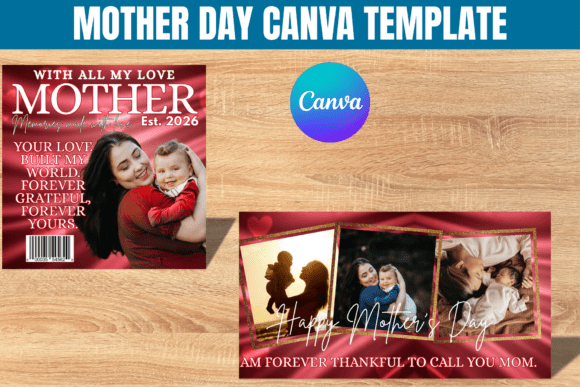
When I opened the Mother Day Canva Template, my first thought wasn’t “cute”—it was “wait, how will this translate to thread?” The layout leans into soft curves, gentle script lettering (“Mom,” “Love You,” or similar phrases), and often includes a minimalist gift box motif—sometimes with ribbon, floral accents, or subtle hearts. Visually, it feels warm and personal—not overly ornate, not too trendy. That’s promising. But as someone who’s stitched hundreds of Mother’s Day pieces for clients (from embroidered baby onesies to boutique aprons), I know charm on screen rarely guarantees clarity under needle.
Where This Template Actually Shines in Embroidery
The Mother Day Canva Template works best when treated as a *starting point*—not a finished embroidery file. Think of it as clean graphic scaffolding for real-world stitching. I recently used a version of it to design a custom embroidered tote bag for a local florist’s Mother’s Day pop-up. We adapted the gift box icon into a small satin-stitched appliqué patch (3.2” wide), paired with a single-line running stitch version of “For Mom” beneath it. The result? Crisp, legible, and quietly elegant—exactly what handmade shoppers expect from a $48 boutique item.
It also holds up well on sweatshirt embroidery—especially when simplified. The original Canva layout has enough negative space and balanced weight that shrinking it to 2.5” for a left-chest placement doesn’t collapse the details. Same goes for pillow covers and tea towels: the composition naturally centers itself, avoids crowded corners, and leaves room for fabric texture to breathe. For Etsy sellers offering personalized gifts, that’s gold—it means fewer customer questions about sizing, fewer re-dos, and more repeat buyers.
Where Caution Is Essential
This isn’t a plug-and-stitch machine embroidery design. Because it’s built in Canva as editable graphics—not vector paths or digitized stitch files—you’ll need to adapt it carefully before embroidering. Tiny script fonts? They’ll vanish on stretchy fabric unless converted to bold, open satin stitches or replaced entirely. Delicate ribbon swirls? High stitch density there can pucker thin cotton or linen. And that lovely dotted heart border? On dark fabric, it may disappear without careful thread color contrast testing.
I tried one variation on a lightweight cap—and regretted it. The curved surface distorted the box shape, and the fine lines lost definition. Save the Mother Day Canva Template for flat, stable surfaces: tote bags, tea towels, baby blankets, apron pockets, or pillow fronts. Avoid it for caps, curved seams, or anything meant for heavy laundering unless you’ve manually adjusted spacing, reduced detail, and added underlay stitches.
What It Adds (and Doesn’t Add) to Your Finished Product
Used well, the Mother Day Canva Template elevates perceived value. Customers recognize thoughtful design—even if they don’t know digitizing terms. A clean, intentional gift box motif signals care, not mass production. That builds trust, especially for craft businesses selling handmade products online. But—and this matters—it won’t fix poor execution. If your stabilizer choice is wrong or your hoop tension inconsistent, even the prettiest Canva layout becomes a puckered mess.
It also supports brand consistency beautifully. Say you sell matching mom-and-baby sets: use the same core box motif across a onesie, a muslin drawstring bag, and a linen tea towel. The visual thread ties your shop together. Just remember—this is a graphics template, not a licensed embroidery file. Before listing finished items on Etsy or at a craft fair, confirm your commercial use rights. Some Canva templates restrict resale of physical products made from them.
Practical Designer Notes Before You Stitch
- Always test on scrap fabric first—especially if using textured weaves like burlap or terry cloth.
- Check thread color contrast on both light and dark backgrounds. What reads clearly on white canvas may vanish on navy twill.
- Review stitch density manually. Canva graphics don’t auto-optimize for fill stitch coverage—dense areas may require reduced density or alternate stitch types.
- Confirm hoop size compatibility. That delicate ribbon loop might exceed a 4×4 hoop unless scaled down.
- Inspect small details at actual stitch size: tiny dots, narrow stems, or fine serif letters often need simplification or removal.
- Test black-and-white mockups to assess silhouette strength—embroidery relies on shape, not color gradients.
- Use appropriate stabilizer: cutaway for knits, tear-away for stable wovens, and fusible for lightweight linens.
- Verify licensing before selling physical items or bundling the design as part of a digital embroidery kit.
Final Thought: A Quietly Versatile Asset
The Mother Day Canva Template won’t wow with complexity—but it doesn’t need to. Its strength lies in flexibility, emotional resonance, and ease of adaptation. For small shop owners building cohesive seasonal collections, for embroidery designers prepping client mockups, or for hobbyists making heartfelt gifts—it’s a reliable, low-friction starting point. Just remember: great embroidery begins where the graphic ends. Respect the fabric, honor the stitch, and let the sentiment speak through clarity—not clutter.