Keychain Care Card Canva Template B W 2 Graphics
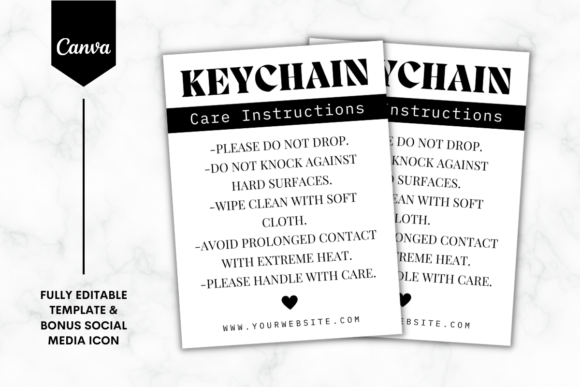
As a graphic designer who’s built brand identities for over a dozen handmade businesses—from ceramic studios to candle makers—I opened Keychain Care Card Canva Template B W 2 expecting something functional. What I found was unexpectedly cohesive: a minimalist, high-contrast black-and-white layout with intentional negative space, clean typography zones, and a subtle structural rhythm that feels both archival and approachable. It doesn’t shout—it invites attention through clarity. That makes it ideal for small business branding where warmth and professionalism must coexist, like a local apothecary launching a limited-edition keychain line or an Etsy seller bundling care instructions with every purchase.
A Quiet Anchor in Packaging & Product Presentation
This isn’t a flashy illustration or decorative clipart—it’s a graphic design asset built for utility without sacrificing aesthetic integrity. In real client work, I’ve used Keychain Care Card Canva Template B W 2 as the backbone of product mockups, especially when designing for print-on-demand platforms or craft fairs. Its balanced grid accommodates logos, care icons, and precautionary text without visual clutter—critical when space is tight on a 2” x 3.5” card. The template supports brand identity by offering consistent placement for brand voice: a handwritten note section pairs beautifully with script fonts, while the warnings block holds up against bold sans serif treatments. It performs well in packaging design, sticker design, and even scaled-down social media graphics for Instagram Stories highlighting product care.
Where It Shines—and Where It Needs Guardrails
Keychain Care Card Canva Template B W 2 excels in printable design contexts: think holiday market kits, boutique gift sets, or subscription box inserts. Its monochrome foundation ensures crisp output across inkjet, laser, and sublimation printers—no color calibration headaches. It also integrates smoothly into Cricut projects, especially when cut as a vinyl overlay or engraved onto wood or acrylic tags. As a Canva template, it’s editable in seconds—swap fonts, adjust spacing, drop in brand colors via accent lines (if modified), and export for web or print.
But here’s what I advise clients: avoid using it at under 1.5” height without testing legibility first. At tiny scales, the fine strokes in some included font pairings can blur. It also shouldn’t anchor minimalist branding that relies solely on whitespace and ultra-thin type—this template carries quiet weight, not silence. And while it’s versatile, it’s not neutral: its structure implies intentionality, so it feels mismatched in corporate annual reports or legal disclaimers where clinical detachment is preferred.
Readability, Trust, and the Unspoken Language of Care
What elevates Keychain Care Card Canva Template B W 2 beyond utility is how it shapes perception. A care card isn’t just information—it’s a tactile extension of your brand’s empathy. This template reinforces visual trust through clear hierarchy: primary instruction first, secondary details second, warnings last—but never alarmist. That deliberate flow signals competence and care, which directly impacts audience engagement and repeat purchase behavior. For handmade businesses, that emotional resonance matters more than ornate decoration. I’ve seen clients report higher unboxing satisfaction scores after switching from generic PDFs to branded cards built from this template.
Designer Notes You Can’t Skip Before Client Use
- Test it in true black and white—some “B&W” templates sneak in grayscale gradients that muddy on thermal printers.
- Check contrast on both light and dark backgrounds, especially if repurposing for digital ads or website banners.
- Preview at 50%, 100%, and 200% scale—verify alignment holds and spacing stays breathable.
- Place it on realistic mockups: hangtag, kraft box insert, corkboard flatlay—to assess real-world presence.
- Confirm print quality with a physical proof: look for halftone artifacts, edge sharpness, and bleed handling.
- Review file formats: if PNGs are included, inspect transparency edges; if SVGs exist, test vector scalability in Illustrator or Canva.
- Compare font compatibility: try pairing with serif (e.g., Merriweather), sans serif (e.g., Inter), script (e.g., Pacifico), and display fonts (e.g., Bebas Neue) to see which reinforces—not competes with—the template’s tone.
- Verify commercial licensing before using in an Etsy product, print-on-demand listing, or client deliverable—this is non-negotiable for professional commercial design.
More Than a Template—A Brand Consistency Tool
In my work with small business clients, consistency across touchpoints builds recognition faster than any single campaign. Keychain Care Card Canva Template B W 2 becomes part of that system: same spacing logic as their email headers, same typographic discipline as their Instagram highlights, same restraint as their packaging tape seal. When used alongside other assets in a design bundle, it strengthens modern design cohesion without demanding uniformity. It’s flexible enough for seasonal updates—swap autumnal icons for spring florals—and sturdy enough to remain unchanged for years. That longevity makes it a smart investment for digital product creators building scalable creative marketplace offerings.
Final Verdict: Purpose-Built, Not Trend-Driven
If you’re sourcing design assets for a client project rooted in authenticity—whether it’s a handmade business launching its first product line or a content creator developing a premium printable collection—Keychain Care Card Canva Template B W 2 delivers quiet authority. It doesn’t chase trends. It solves problems: How do we communicate care without clutter? How do we honor craftsmanship in the smallest detail? How do we make instructions feel like part of the experience—not an afterthought? That’s the mark of a mature creative design solution. Use it thoughtfully, test rigorously, and let it do what it does best: ground your visuals in clarity, respect, and quiet confidence.