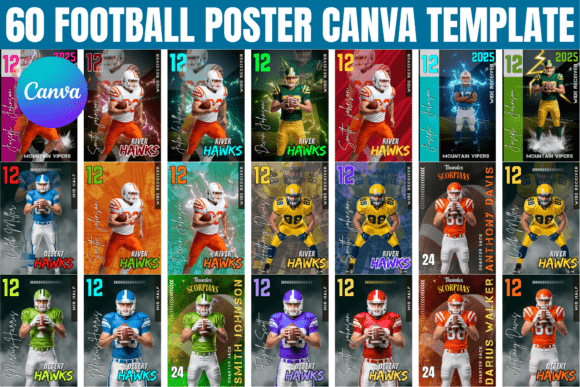
60 Football Poster Canva Template
As a designer who’s stitched everything from baby onesies to boutique aprons—and reviewed hundreds of digital design assets for embroidery use—I opened the 60 Football Poster Canva Template expecting bold, clean, and production-ready visuals. What I found wasn’t just “football-themed”—it was a cohesive visual toolkit built for memory-making, not just decoration. But here’s the real question: does it translate well into embroidery? Not as a flat graphic, but as a machine embroidery design that holds up on fabric, reads clearly at scale, and feels handmade—not digitized.
First Impression: Bold, Nostalgic, and Surprisingly Versatile
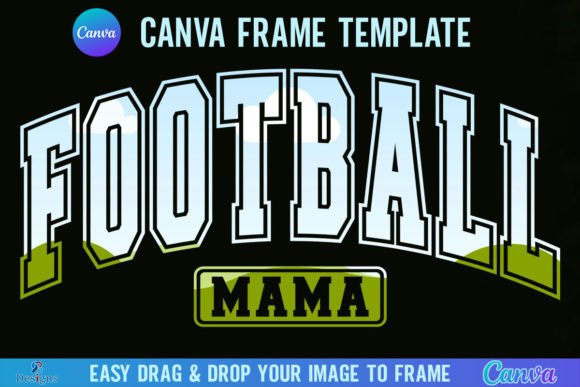
The 60 Football Poster Canva Template lands with strong visual rhythm—think vintage sports posters meets modern senior portrait energy. It’s got layered typography, subtle textures (like grainy paper or soft halftones), and football motifs that lean into silhouette, iconography, and symbolic framing rather than photorealism. That’s good news: minimal fine detail means fewer stitch-density headaches later. The layout is intentionally generous—plenty of breathing room around central elements—which gives you flexibility to crop, reposition, or isolate parts for embroidery without losing impact.
I immediately pictured this on a heavyweight cotton tote bag for a high school senior’s football send-off. Not as a full poster print—but as an embroidered crest-style motif in the upper corner: helmet + number + name, rendered in satin stitch with a subtle fill-stitch background. That kind of restrained use lets the 60 Football Poster Canva Template shine without overwhelming the garment.
Where It Works Best—And Where It Needs Caution
This isn’t a one-size-fits-all embroidery file—it’s a graphics pack designed for Canva, so adaptation is part of the process. That said, its strengths align beautifully with several real-world embroidery applications:
- Custom apparel: Sweatshirts, crewnecks, and quarter-zips benefit from its bold lettering and centered compositions—especially when simplified to single-color outlines or monochrome layouts.
- Embroidered patches: Several templates feature clean borders and contained shapes ideal for die-cut or sew-on patches. Just confirm your digitizer can simplify gradients or texture overlays into stitch-friendly zones.
- Baby embroidery: A few softer, rounded designs (think football + stars or script + jersey numbers) translate gently onto onesies or burp cloths—provided you avoid dense fill areas near seams.
- Holiday or milestone gifts: Think graduation caps, framed pillow covers, or tea towels for tailgates. Its “Memory Mate” energy makes it feel personal, not mass-produced.
- Craft business branding: Use one clean template as a consistent header across Etsy listings or printable mockups—then embroider a simplified version on product tags or packaging.
But caution applies where precision matters most:
- Small hoop sizes: Avoid templates with tight clusters of tiny text or interlocking elements unless you’re willing to edit or scale down significantly.
- Textured or stretchy fabric: Heavy grain effects or shadow layers may blur or distort on terry cloth, knits, or fleece—test first with stabilizer appropriate for the base fabric.
- Dark fabric backgrounds: Some templates rely on light-on-dark contrast; verify legibility in black-and-white mockups before stitching.
- Curved surfaces like caps: Stick to centered, horizontal layouts—not tall vertical banners—unless you’re using a cap frame and adjusting for distortion.
- Frequent-wash items: Avoid overloading with dense fill stitches in high-friction zones (e.g., tote bag straps or sweatshirt cuffs).
Design Integrity Meets Handmade Value
What sets the 60 Football Poster Canva Template apart isn’t novelty—it’s consistency. All 60 pieces share tonal harmony, balanced negative space, and intentional hierarchy. That means when you adapt even one design for embroidery, it carries weight. Customers notice that. A personalized football sweatshirt with a crisp, well-spaced embroidered number doesn’t look like a last-minute add-on—it looks like a finished product, not a placeholder.
For Etsy sellers and small shop owners, that perception directly affects perceived value, repeat orders, and word-of-mouth trust. When a parent orders a baby embroidery set and receives a tiny, thoughtfully scaled football motif—clean, legible, and balanced—they’re more likely to tag your shop or request matching items. That’s the quiet power of starting with strong design assets.
Practical Embroidery Designer Notes
Before stitching or selling:
- Test on scrap fabric first—especially if pairing with textured or dark materials.
- Review thread color contrast: Swap out default palette suggestions for high-visibility combos (e.g., navy thread on cream twill, white on charcoal).
- Check stitch density in any fill areas—dense blocks can stiffen lightweight fabrics or cause puckering.
- Confirm hoop size compatibility with your machine and intended placement (e.g., left chest vs. back panel).
- Inspect small details like serifs, dots, or thin lines—these often vanish or bleed in satin stitch.
- Try black-and-white mockups to gauge readability without color distraction.
- Use proper stabilizer: Tear-away for stable wovens, cut-away for knits, and topping for fuzzy or napped surfaces.
- Verify licensing for commercial use—especially if selling finished embroidered goods or bundling with digital embroidery files.
The 60 Football Poster Canva Template won’t auto-translate into perfect embroidery—but it gives you a thoughtful, cohesive foundation. As a designer, I appreciate that. It respects my time, my machine, and my customers’ expectations. Used intentionally—not as a drop-in replacement, but as curated inspiration—it becomes part of something warmer, more personal, and unmistakably handmade.